Ideas that move your business forward
Insights on better websites, smarter technology, and digital growth from the team that builds them.
Featured insight
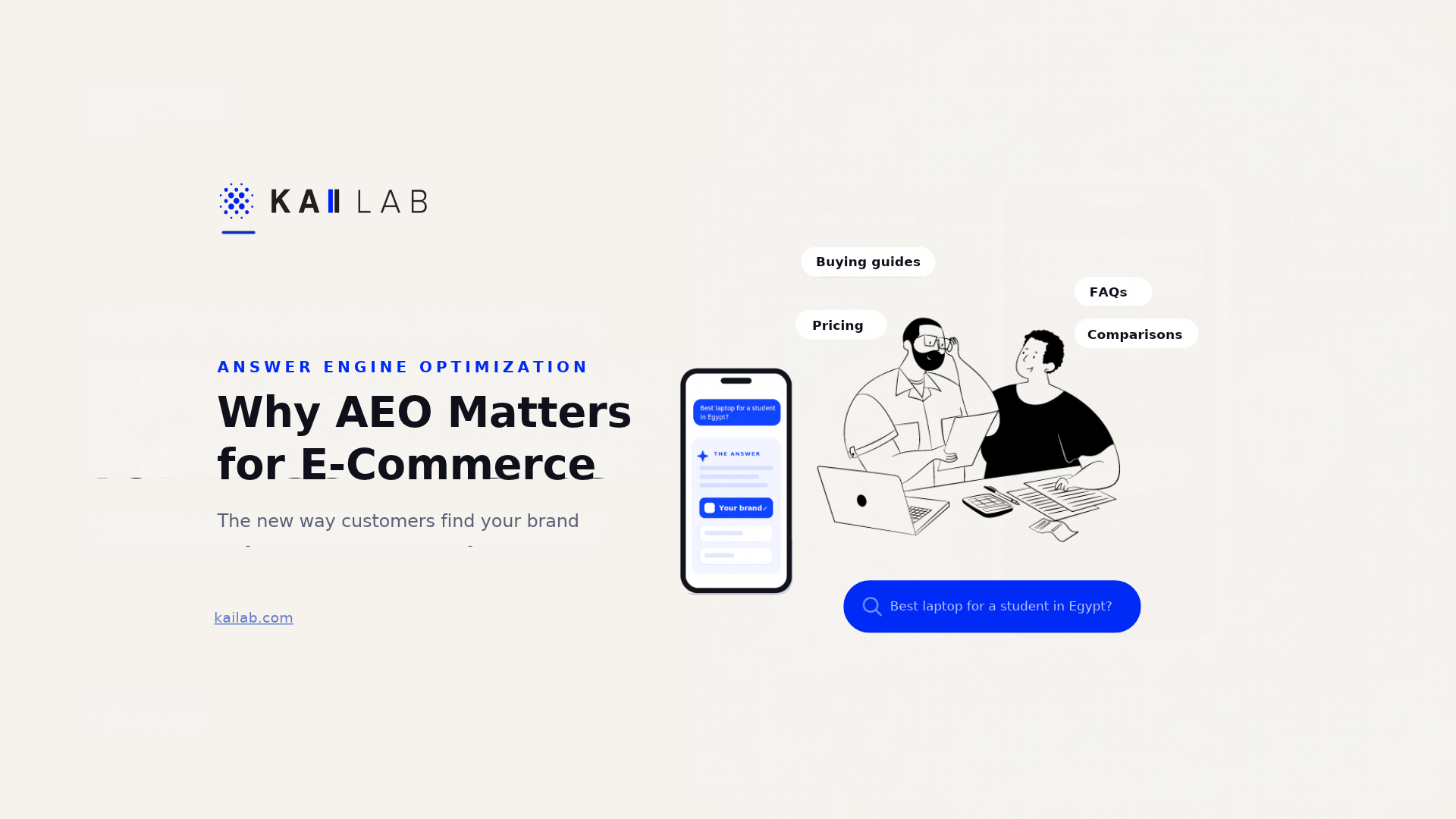
Why AEO Matters for E-Commerce: The New Way Customers Find Your Brand
For years, e-commerce brands have focused on one question: How do we rank higher on Google? Today, there is another question brands need to ask: When a customer asks an artificial intelligence tool for a recommendation, will our brand be part of the answer? This is where Answer Engine Optimization becomes increasingly important. And for e-commerce businesses in Egypt, the opportunity is significant.
Egypt is already a digital-first market
According to DataReportal's Digital 2026: Egypt report, Egypt had 98.2 million internet users at the end of 2025, representing 82.7 percent of the population.
Egypt also had 51.6 million social media user identities, while the number of internet users increased by 2.3 million between October 2024 and October 2025.
At the same time, the United States Department of Commerce reports that Egypt has the largest population of internet users in the Middle East and North Africa, while e-commerce continues to expand alongside smartphone adoption and digital infrastructure.
For e-commerce brands, this means one thing:
There is a massive digital audience looking for products, information, comparisons, and recommendations.
But the way people find that information is changing.
From searching for links to asking for answers
Traditional Search Engine Optimization helps your website become more visible when someone searches for something like:
Best laptops in Egypt
Answer Engine Optimization takes this one step further.
A customer might ask:
What is the best laptop for a university student in Egypt under 30,000 Egyptian pounds?
Or: Which Egyptian online store offers installment plans for home appliances?”
Or: What should I look for when buying an air conditioner for a small bedroom?”
These are not simply keyword searches.
They are questions that require answers.
For e-commerce brands, this creates a new opportunity to appear during the research and decision-making stage of the customer journey.
Egyptian e-commerce brands are already moving in this direction
Some businesses in the Egyptian market are already publishing content that follows many of the principles behind Answer Engine Optimization.
Take B.TECH, for example.
Its website goes beyond product listings by publishing detailed buying guides, comparisons, pricing guides, product explanations, and frequently asked questions.
Its content includes questions such as:
How do I choose the right laptop for my needs?
What is the average price of laptops in Egypt?
What is the difference between an inverter air conditioner and a regular air conditioner?
This type of content directly addresses the questions customers ask before making a purchase.
Jumia Egypt also uses extensive category information, frequently asked questions, product attributes, buying guidance, and comparison-oriented content across its marketplace.
This does not mean that these brands are necessarily being consistently recommended by artificial intelligence answer engines. Rather, their approach demonstrates an important principle:
E-commerce content needs to answer the customer's question, not simply describe the product.
Why does this matter for your e-commerce business?
Imagine a customer is interested in buying skincare products.
They may not start by searching for your brand.
They might ask:
What should I look for in a moisturizer for dry skin?
If your website contains a clear, useful answer, supported by relevant products and structured information, you have created another opportunity for your brand to enter the customer's consideration process.
The same applies to almost every e-commerce category.
- Fashion.
- Beauty.
- Electronics.
- Furniture.
- Food.
- Home appliances.
The questions may be different, but the principle is the same.
Your website should answer:
- What is the product?
- Who is it for?
- How does it compare with alternatives?
- How much does it cost?
- How should customers choose between different options?
- What are the common questions before purchasing?
- What happens after the purchase?
When your website answers these questions clearly, you are creating content that is useful to both people and answer engines.
Answer Engine Optimization is not a replacement for Search Engine Optimization
It is an evolution of how we think about search visibility.
Search Engine Optimization focuses on helping search engines discover, understand, and rank your website.
Answer Engine Optimization focuses on making your content clear and useful enough to be incorporated into direct answers and conversational search experiences.
For e-commerce brands, both matter.
Because getting someone to discover your brand is only the first step.
The bigger opportunity is helping them understand why they should consider your product.
So, where should Egyptian e-commerce brands start?
Start with your customers' questions.
Look at your:
- Product pages
- Category pages
- Frequently asked questions
- Buying guides
- Comparison pages
- Product specifications
- Shipping and return information
- Customer reviews and questions
Then ask: If someone asked an artificial intelligence tool about products in our category, would our website provide a clear enough answer for our brand to be understood?
If the answer is no, there is an opportunity to improve.
Because the future of e-commerce visibility is not only about being found.
It is about being understood.
And ultimately, it is about becoming one of the brands customers discover when they are ready to make a decision.
Want to see what Answer Engine Optimization could look like for your e-commerce website?
At Kaii Lab, we help e-commerce businesses build digital experiences and websites designed around how customers actually search, evaluate, and buy.
Explore topics
Latest insights

SEO Case Study – 4000% Increase in Organic Traffic in 1 year
In this article, we’ll walk you through how we created a content website that has grown in organic traffic by 41x (~4000%) in the last 12 months. This website got 521 visitors in October 2022 vs. 21,360 visitors in October 2023, all visitors are from Google. We’ll share exactly how we planned and executed the main SEO strategies that led to this growth. We’ll also dive into the steps we’re taking to monetize it and what we’re planning for the future of this website. So without further ado, let’s get into the meat of this case study.
“Egyptian Bites” SEO Case Study
Before we break down the actual strategies, let me give you a quick introduction to the website.
Egyptian Bites is a content website or a “blog” containing articles that curate the top restaurants in different cities, neighborhoods, malls, compounds, and even streets in Egypt.
The website currently has more than 100 articles and pages covering different areas in Sheikh Zayed, New Cairo, Maadi, El Gouna, and Alexandria, with plans to scale across the entire country.
It was launched in September 2022 with the intention to fill the content gap on Google in the Egyptian F&B industry.
Key Takeaways / Steps
- Researching and picking an industry or topic that is underserved on Google.
- Doing keyword research that is suitable for a new website.
- Planning your site's structure. Creating clear categories and subcategories that all the articles (keywords) fall under.
- Working on articles in “clusters” and adding internal links between related articles.
1- The Idea
We're all aware that the food review industry is super saturated on social media platforms like TikTok, Instagram, etc. But what about Google?
Try Googling something like “Italian restaurants in Maadi” and check the results on the first page of Google.
These results do not meet the search intent that the users and Google are expecting to see. It's crucial to understand and fulfill the search intent if you're looking to rank your website pages on Google.
The search intent here is to provide a list of the top Italian restaurants in Maadi. So, not in “Egypt”, not a page that features only one restaurant, and preferably not a page that has no content or details about each restaurant listed.
Et voilà! That's when we realized that could be a golden opportunity. A chance for us to find hundreds and thousands of other similar keywords that are underserved on Google and that people actually search for a lot on a monthly basis.
2- Approach and Research
To verify that this is a real opportunity, we had to do our research and make sure there are a handful of keywords in the same niche or category, whether in English or Arabic.
We found out that there's an even bigger opportunity in Arabic. Keywords like مطاعم اركان بلازا and مطاعم وصلة دهشور were on the list of high-volume keywords that were clearly underserved on Google.
Initially, we found dozens of Arabic keywords of the same type, so we decided to give this project a go.
We did our keyword research using a well-known tool in the SEO industry called Semrush. There are cheaper alternatives to this tool like Ubersuggest, Google Keyword Planner, and KeySearch.
Finding Low Difficulty Keywords Using Semrush
Keyword research can make or break your whole SEO strategy, especially when you're working on a brand new website. A brand new website doesn't have any factors that make Google trust it, unlike more established websites.
This is why, as a new website, you're better off going for keywords that have lower competition on Google so that you have a chance to rank and start getting traffic.
The simplest way to start is to feed a tool like Semrush a relevant seed keyword. In our case, one very obvious seed keyword is مطاعم.
The search volume represents how many times a specific keyword is searched on a monthly basis. What you should be looking for is the lowest possible keyword difficulty combined with the highest volume.
This process is much deeper than this, and it's better to manually verify that the keywords are easy to rank for. However, this is a good start, and the numbers provided by Semrush are good initial indicators.
The Importance of “Topical Authority”
“Topic authority” as mentioned in the Google guidelines is covering a specific topic thoroughly to be seen by Google as an “Authority” in this niche or topic.
This is especially vital for smaller websites that are trying to gain Google's trust.
For example, if you're a brand new website that is trying to rank for diverse keywords like “best laptop”, “best tablet”, and “best mobile”, you're better off starting in one sub-niche, let's say tablets for example.
This will allow you to build a better “Topic Authority” in the tablets category.
In this case, you can go for keywords like “best tablets for gaming”, “best tablets for architects”, etc.
I believe this is the ultimate deal-maker SEO tactic for new websites. This strategy can be implemented on any niche and any website type to establish a solid topical authority in the eyes of Google.
You can contact us if you're looking to outsource this process. We've done it dozens of times for different website types (e-commerce, B2B, content sites, & more).
3- Website Design & Development
Initially, we didn't take the professional website design and development route. We couldn't dedicate the needed resources to have a professionally designed website at the beginning, so we created a basic WordPress website (anyone can do it).
Note: Our technical team was busy with a handful of client projects and they didn't have enough time to spare for an internal project.
“Done is better than perfect”, especially when you have limited resources.
We decided to make a quick design revamp when we started to get some traffic from Google after a few months of launching the website. Special thanks to our talented technical team.
I believe that it's crucial to plan your resources from the start and make sure you invest in what will bring you the best results.
In our case, our main product and best investment is definitely content. I'll talk more about how we went through the content creation and optimization process in the coming section.
4- Content Creation & Optimization
After putting together a very basic content strategy that includes the main keywords, content calendar, and a basic article template, we were ready to start writing our first article.
As an attempt to build a solid topical authority foundation, we decided to go for a geo-based content plan. We had prepared keyword groups that are categorized by areas and cities in Cairo.
Starting with Sheikh Zayed city, we wrote and published more than 40 articles covering different areas in Sheikh Zayed and October.
We started publishing in September and we reached 42 published articles halfway through November. This means that we published 4-5 new articles per week, on average, for the first 2 months.
It's important to mention that we had about 10-15 articles that were written in advance, which gave us a publishing boost at the beginning without the need to actually write 5 articles per week.
A good target or benchmark in my opinion would be an average of 2 articles per week.
Content Optimization
You should always prioritize adding value and providing useful content over any SEO tactics.
That said, it's also important that you optimize your content for Google and other search engines.
Basic on-page optimization techniques include:
- Adding the main keyword to the title, slug (URL), one of the subheadings in the article, and in the introduction or conclusion if possible.
- Adding relevant internal links to related articles on your website (Very Important).
- Adding external links to useful resources on other websites.
Other techniques that will help elevate the quality of your content:
- Creating a content rule book that defines the tone and style of the website. This is particularly helpful if you're outsourcing content.
- Having an author box to give the reader information on who's behind each article.
Advanced content optimization techniques:
- Adding structured data to improve your chances of getting featured on rich results.
- Writing in an NLP-friendly way. Experts say it increases your chances to rank on Google.
5- Monetization & Future Plans
Last but definitely not least, I'll delve into what we did and what we're planning to do in order to make Egyptian Bites a revenue-generating business.
We started adding display ads to Egyptian Bites through a Google-Certified Ad Network. You can easily apply, and their team will review your website and make sure it doesn't violate either their or Google's policy.
When your website is approved, they'll let you know the next steps on how to set up your website to start showing ads.
Display Ads are not our primary monetization method due to the low RPMs (Revenue per thousand visitors) for visitors from North Africa. This is due to a number of reasons that are not within scope of this article, so I'll skip explaining this part for now.
Our primary monetization strategy is to allow restaurants to advertise on different pages of our website based on their location, cuisine, etc.
Here are some of the advantages restaurants can enjoy when they advertise on our website.
Super Targeted Traffic
Our website gets over 25,000 visitors from Google on a monthly basis.
The interesting part is that all the visitors land on our website after searching something very specific like “best restaurants in Arkan Plaza”, for example.
This makes our website very efficient in converting visitors into clients or customers for restaurants, because the visitor is the one looking for what we're offering, not vice versa.
On the other hand, social media ads, for example, don't work the same way. You, as a business, will show your ads to people who are probably interested or were interested in a specific service one day, but this won't guarantee that your ads will show to someone who is actually searching for your service right now.
Egyptian Bites guarantees that.
Future Plans
We believe Egyptian Bites will be a leading content website in the F&B industry and has the potential to be a very successful business inshallah.
We're currently looking for sponsors to invest more in content quality and quantity and provide helpful advice for searchers on Google.
Wrapping Up
We'll keep working on our main product (content and SEO), and we're currently exploring new monetization techniques that would help us maintain and improve our content and website.
If you're a restaurant owner who's interested in being featured on Egyptian Bites, reach out to us at info@kaiilab.com.
You can also contact us if you have any kind of business and want to explore our SEO services.
Why AEO Matters for E-Commerce: The New Way Customers Find Your Brand
For years, e-commerce brands have focused on one question: How do we rank higher on Google? Today, there is another question brands need to ask: When a customer asks an artificial intelligence tool for a recommendation, will our brand be part of the answer? This is where Answer Engine Optimization becomes increasingly important. And for e-commerce businesses in Egypt, the opportunity is significant.
Egypt is already a digital-first market
According to DataReportal's Digital 2026: Egypt report, Egypt had 98.2 million internet users at the end of 2025, representing 82.7 percent of the population.
Egypt also had 51.6 million social media user identities, while the number of internet users increased by 2.3 million between October 2024 and October 2025.
At the same time, the United States Department of Commerce reports that Egypt has the largest population of internet users in the Middle East and North Africa, while e-commerce continues to expand alongside smartphone adoption and digital infrastructure.
For e-commerce brands, this means one thing:
There is a massive digital audience looking for products, information, comparisons, and recommendations.
But the way people find that information is changing.
From searching for links to asking for answers
Traditional Search Engine Optimization helps your website become more visible when someone searches for something like:
Best laptops in Egypt
Answer Engine Optimization takes this one step further.
A customer might ask:
What is the best laptop for a university student in Egypt under 30,000 Egyptian pounds?
Or: Which Egyptian online store offers installment plans for home appliances?”
Or: What should I look for when buying an air conditioner for a small bedroom?”
These are not simply keyword searches.
They are questions that require answers.
For e-commerce brands, this creates a new opportunity to appear during the research and decision-making stage of the customer journey.
Egyptian e-commerce brands are already moving in this direction
Some businesses in the Egyptian market are already publishing content that follows many of the principles behind Answer Engine Optimization.
Take B.TECH, for example.
Its website goes beyond product listings by publishing detailed buying guides, comparisons, pricing guides, product explanations, and frequently asked questions.
Its content includes questions such as:
How do I choose the right laptop for my needs?
What is the average price of laptops in Egypt?
What is the difference between an inverter air conditioner and a regular air conditioner?
This type of content directly addresses the questions customers ask before making a purchase.
Jumia Egypt also uses extensive category information, frequently asked questions, product attributes, buying guidance, and comparison-oriented content across its marketplace.
This does not mean that these brands are necessarily being consistently recommended by artificial intelligence answer engines. Rather, their approach demonstrates an important principle:
E-commerce content needs to answer the customer's question, not simply describe the product.
Why does this matter for your e-commerce business?
Imagine a customer is interested in buying skincare products.
They may not start by searching for your brand.
They might ask:
What should I look for in a moisturizer for dry skin?
If your website contains a clear, useful answer, supported by relevant products and structured information, you have created another opportunity for your brand to enter the customer's consideration process.
The same applies to almost every e-commerce category.
- Fashion.
- Beauty.
- Electronics.
- Furniture.
- Food.
- Home appliances.
The questions may be different, but the principle is the same.
Your website should answer:
- What is the product?
- Who is it for?
- How does it compare with alternatives?
- How much does it cost?
- How should customers choose between different options?
- What are the common questions before purchasing?
- What happens after the purchase?
When your website answers these questions clearly, you are creating content that is useful to both people and answer engines.
Answer Engine Optimization is not a replacement for Search Engine Optimization
It is an evolution of how we think about search visibility.
Search Engine Optimization focuses on helping search engines discover, understand, and rank your website.
Answer Engine Optimization focuses on making your content clear and useful enough to be incorporated into direct answers and conversational search experiences.
For e-commerce brands, both matter.
Because getting someone to discover your brand is only the first step.
The bigger opportunity is helping them understand why they should consider your product.
So, where should Egyptian e-commerce brands start?
Start with your customers' questions.
Look at your:
- Product pages
- Category pages
- Frequently asked questions
- Buying guides
- Comparison pages
- Product specifications
- Shipping and return information
- Customer reviews and questions
Then ask: If someone asked an artificial intelligence tool about products in our category, would our website provide a clear enough answer for our brand to be understood?
If the answer is no, there is an opportunity to improve.
Because the future of e-commerce visibility is not only about being found.
It is about being understood.
And ultimately, it is about becoming one of the brands customers discover when they are ready to make a decision.
Want to see what Answer Engine Optimization could look like for your e-commerce website?
At Kaii Lab, we help e-commerce businesses build digital experiences and websites designed around how customers actually search, evaluate, and buy.